

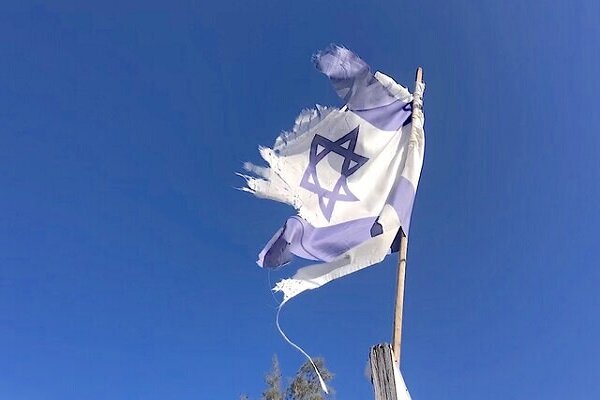
Prolonged wars, economic pressure, political disputes, and rising social discontent have pushed Israeli society into a phase whose consequences are being warned about even in American security circles.
According to a confidential report attributed to the US Central Intelligence Agency, experts at the agency have warned about the possibility of civil war or political collapse in the occupied territories. This report, prepared under the title "Infiltration from Within," examines a set of pressures that, if simultaneous, could confront the political and social stability of the Zionist regime with a serious crisis; from the increase in military costs and economic pressure to the mental and psychological problems of forces returning from war, the dispute over Haredi military service, and Benjamin Netanyahu's effort to preserve power.
The aforementioned report also refers to the rise in food prices and the costs that Israeli society has incurred as a result of warmongering policies. The issue is not just the rising price of goods; rather, the increase in living costs has occurred under conditions in which a significant portion of the regime's financial resources is spent on military operations and covering security costs. Under such circumstances, war is no longer merely a matter related to the battlefield and has directly entered the daily lives of citizens.
This is precisely the point at which a security crisis can turn into a social crisis. A society that, for a short period, is willing to tolerate economic and social pressures under the influence of a wartime atmosphere, if it feels that the war has become prolonged, costs have increased, and there is no clear prospect for its end, will gradually raise other questions: What are these costs for? Who is responsible for the continuation of this situation? And have the continuation of current policies really created more security?
In the Zionist regime, these questions are also tied to an older fissure; the fissure among different groups of society over the extent of participation in the military and security project. The dispute over Haredi military service is a clear example of this issue. Under normal conditions, such a dispute might be considered merely a political or legal controversy, but when a regime is engaged in a prolonged war and repeatedly sends a large part of its forces to the field, the feeling of discrimination in the distribution of the burden of war can become a factor in intensifying social divisions.
On the other hand, the return of military forces from a long period of conflict can itself have widespread social and psychological consequences. Mental pressures, exhaustion, psychological damage, and the difficulty of returning to normal life are not issues that disappear with the end of a military operation. The more the scope and duration of the conflict increase, the more the number of individuals who return to society with such an experience also increases. Therefore, part of the cost of war may manifest itself when the battlefield is no longer at the center of media attention.
Alongside all these factors, the political crisis also persists. Netanyahu's performance and his effort to preserve his political position is one of the main axes of internal disputes in the Zionist regime. The important issue is that when the political fate of a politician becomes tied to the continuation of a security crisis, the boundary between security decision and political expediency can become ambiguous for public opinion. In such a situation, every new military decision may, in addition to security consequences, also acquire a political interpretation.
This situation becomes even more significant especially on the eve of elections. Elections in any society can intensify political disputes, but in a society that is simultaneously facing economic pressure, casualties, military exhaustion, and social divisions, electoral competition can become a ground for the emergence of deeper fissures. For this reason, the warning about the possibility of a "spark" forming is important; because major social crises do not always necessarily begin with one big dispute. Sometimes a collection of small and accumulated disputes needs only one incident to turn into a widespread crisis.
The more important point is the issue of the Zionist regime's increasing isolation on the international stage. Over the past decades, this regime has obtained an important part of its power not only from military capability, but from the political and economic support of America and extensive relations with Western countries. Therefore, any sign of a reduction in this support can have psychological and political effects beyond a diplomatic dispute. A society that sees itself as losing external backing may also fall into doubt about its leaders' ability to manage the future.
Of course, the possibility of political collapse or civil war should not be taken to mean its definite occurrence. The Zionist regime still possesses powerful military, security, and political structures and has considerable ability to manage crises. But the important issue is that the set of pressures that existed separately in recent years are now becoming simultaneous. It is this very simultaneity that can turn a potential vulnerability into a real crisis.
In fact, the main point of weakness may lie not at the borders, but within society. A regime can respond to a missile attack, a military operation, or external pressure with security tools, but confronting public distrust, the erosion of social capital, division among different groups, and dissatisfaction with political performance is far more difficult.
The importance of this report lies precisely here. This time, the discussion is not just about the failure of an operation or a setback on a specific battlefield; the discussion is about the capacity of a political structure to withstand accumulated pressures. If economic pressure, war-induced exhaustion, social divisions, political crisis, and reduced foreign support intensify simultaneously, even a limited incident can become the starting point of a larger crisis.
The Zionist regime has for years tried to present an image of power, cohesion, and permanent security. But if this image erodes from within society, an issue arises that cannot be solved with military power. Perhaps the greatest threat to this regime will ultimately not be an attack from outside; rather, it will be the very fissure that has gradually expanded from within.
And it is precisely for this reason that today's issue is not only how much military capability Israel has on the battlefield; the more important issue is how much capacity Israeli society has to tolerate the continuation of this situation. If this tolerance reaches its endpoint, one spark can ignite a crisis whose containment will be very difficult for the political structure of the Zionist regime.
MNA




Your Comment